Choosing the right water bottle capacity is not a matter of selecting the largest option in a catalogue. The useful range depends on the longest practical use period, convenient refill access, filled carrying weight, bottle dimensions, and the space available in a bag or gift box.
For most office, conference, and mixed daily programs, about 450–600 ml is a sensible starting range. Compact 300–400 ml bottles work better when desk, bag, or box space is tight. Capacities around 650–900 ml become more relevant when refill gaps are long and secure carrying is available.
These ranges are planning tools, not universal rules. A suitable stainless steel water bottle gift set still needs to be checked against the actual routine, recipient group, bottle profile, packaging layout, and distribution method.
Water Bottle Capacity Ranges at a Glance
Start with the primary use scenario. The range should narrow the review, while the final product is approved only after its height, diameter, empty weight, lid clearance, and packaging dimensions have been checked.
| Planning range | Strongest starting scenarios | Why it may work | Main issue to test |
|---|---|---|---|
| Compact About 300–400 ml |
Short meetings, small desks, light conference bags, compact mailers, and tightly arranged gift sets | Lower filled weight and easier placement in limited spaces | Frequent refilling during longer sessions or travel |
| Balanced mid-size About 450–600 ml |
Office routines, conferences, commuting, training, and mixed daily use | A practical balance between refill frequency, carrying comfort, and box space | Height and diameter can still cause bag or holder problems |
| Larger About 650–900 ml |
Long travel periods, outdoor programs, field teams, and limited refill access | Fewer refill interruptions over long activity periods | Higher filled weight, greater bulk, and increased packaging volume |
| Extra-large Above 900 ml |
Specialized long-duration use with secure carrying and clear storage support | High volume where practical refilling remains unusually difficult | Bulk, transport, handling, and gift-box compatibility become central limits |
Do not judge carrying weight from an empty sample
Water adds about 0.5 kg to a 500 ml bottle and about 0.75 kg to a 750 ml bottle before the empty bottle weight is included. Test the filled sample inside the complete bag, not in isolation.
Begin with the Hardest Constraint
Capacity selection becomes easier when the condition that cannot change is identified first. It may be a compact conference bag, a long route, a narrow vehicle holder, a fixed storage shelf, or a pre-approved gift box.
Instead of asking which size looks most generous, ask which condition would make the wrong capacity inconvenient. Once that limit is clear, compare a provisional range against the remaining requirements.
Use duration sets the starting range
Estimate the longest realistic gap between convenient refills. A short meeting with a scheduled break creates a different requirement from a multi-hour workshop, while a desk near a pantry creates less pressure than a field location with limited water points.
Formal agenda time can be misleading. A two-hour conference session may also include hotel travel, check-in, networking, lunch movement, and a return journey. The initial water bottle capacity should reflect that complete window, but extra volume should not be used to compensate for weak event planning when better refill access can solve the problem.
Refill access must be genuinely convenient
A water point can exist without being practical. A dispenser on another office floor may interrupt work, and one station near a venue entrance may remain too far from workshop rooms or outdoor activity zones.
Record distance, visibility, opening times, scheduled breaks, and expected queues. Stable office refill conditions often support a compact range. Changing event layouts need closer review, while outdoor routes require the most careful mapping because users may move away from central facilities.
Filled weight changes the carrying experience
An empty bottle can feel light and easy to handle. Once filled, the same product creates a different load during long walks, public transport, airport transfers, and repeated movement between meeting rooms. A short handling test will not reveal that accumulated burden.
Place the sample inside a fully packed bag and carry it through stairs, queues, seating, and normal access to other items. Stationary programs have more flexibility. Mobile programs need a stricter balance between fewer refill stops and a bottle that becomes the heaviest non-essential item in the bag.
Dimensions matter as much as stated volume
Two bottles can hold a similar amount while using very different proportions. A tall, narrow body may fit one side pocket but exceed cabinet height. A shorter, wider design may sit securely on a desk but fail to enter a vehicle holder.
Approve capacity only after checking height, body diameter, base width, lid shape, handle position, and opening clearance. Place the sample beside a laptop, inside the proposed tote, within a common holder, and under the intended shelf.
Use a weighted decision when teams disagree
Marketing may prioritize presentation, event operations may prioritize carton handling, and travel planners may focus on bag fit and filled weight. A simple five-point comparison can score each option against use duration, refill access, carrying comfort, physical fit, cleaning, and packaging.
Give extra weight to the factors that cannot change. For a commuter program, bag fit and carrying weight may lead. For an outdoor activation, refill distance and secure transport may matter most. In a boxed recognition program, insert space and total carton volume can decide the result.
Resolve product form before detailed size comparison
If the project is still deciding between a closed bottle and a desk-oriented tumbler, settle that question first. The bottle vs tumbler comparison explains the portability, desk-use, and lid differences. Capacity can then be compared within the correct category.
Office, Meeting, and Conference Capacity
Office and conference programs share indoor use, but their movement patterns differ. Desk routines usually offer regular refills. Event routines add registration bags, crowded tables, preparation work, and return travel.
Stay-put pattern
Office and desk programs
Regular pantry access often makes a compact or balanced bottle sufficient. Footprint may matter more than a small increase in volume when the bottle sits beside a computer, notebook, phone, and charging equipment.
Include the commute and room-to-room movement in the test. A bottle that looks comfortable on a desk may become awkward beside a laptop and charger.
Move-through pattern
Meeting and conference programs
A conference bottle begins as a packed item, moves through registration, sits on a crowded table, and later enters a travel bag. Short sessions with regular breaks can support a compact option.
Long workshops may justify a balanced mid-size bottle when refilling would interrupt the agenda. Carry-home convenience still matters, especially for international and multi-day events.
Check the complete conference bag
Registration packs may already contain an agenda, badge, notebook, pen, brochure, and event merchandise. A larger bottle affects the complete handout: bag weight, bag opening, packing speed, carton depth, storage behind the desk, and the space recipients need for onward travel.
Assemble one complete bag before approving the quantity. The bottle should pass through the opening without slowing preparation, sit securely beside printed materials, and remain easy to remove. Stack, move, and carry the finished kit to expose problems that a catalogue image cannot show.
Meeting rooms reward controlled dimensions
Meeting spaces range from large boardrooms to narrow classroom-style tables. A wide bottle can remove writing space, while an unnecessarily tall one may feel visually dominant beside laptops and printed material. Short meetings rarely need high volume, but full-morning workshops may justify a moderate increase when leaving the room would interrupt the session.
Shared storage adds another limit. Cabinets, lockers, refrigerator shelves, and monitor stands may have fixed clearance. Test the lid in its open position as well as the closed bottle height; a model can fit beneath a shelf and still lack room for comfortable opening.
Event planning can reduce capacity pressure
Visible refill stations near break areas can make a smaller range more practical. Their location and expected queues matter: one water point near the entrance may not support workshop rooms at the opposite end of a large venue. Improving the refill plan can create a better experience than selecting an inconveniently large bottle.
Travel, Commuting, and Outdoor Use
Mobile programs need stricter testing because the bottle must work inside a moving system. Transport mode, bag load, refill access, carrying method, activity length, and distribution all affect the result.
Start with the packed bag and dominant transport method
Pack the laptop, charger, documents, clothing, and personal items before adding the bottle. Side pockets vary in width and depth, so test several common backpacks, totes, and laptop bags when one model will be distributed to a broad group.
Car travel emphasizes secure holder fit. Rail travel adds crowded platforms, narrow seats, and limited tray space. Air travel adds security, terminal walking, and cabin baggage limits. The most common route should receive the highest priority instead of forcing a compromise around an occasional secondary journey.
Air travel includes an empty-volume test
The bottle may be empty during airport screening, but it still occupies the same physical space. After security, a very small capacity may require repeated refill stops, while a large bottle can compete with essential cabin belongings.
Multi-day trips add hotel use and return packing. Very tall bottles can be awkward to rinse in small sinks; unusually wide designs may consume valuable luggage space even when they are empty.
Test carrying comfort over time
A larger water bottle capacity may feel manageable for several minutes and become tiring after multiple transfers. Bag balance matters too: a heavy side pocket can pull the bag in one direction, while an internal bottle may press against electronics or block access to documents.
For mixed travel, a balanced mid-size direction often limits bulk without demanding constant refills. Long routes with few water points can justify more volume when the bag provides stable support and the bottle does not interfere with essential belongings.
Outdoor programs connect capacity with operations
A fixed booth team can accept a different range from a roaming activation team. A participant with a backpack can carry more securely than someone expected to hold the bottle for several hours. Role-based capacities may be justified, but unnecessary variations complicate packing, carton marking, and on-site distribution.
Additional volume makes more sense when
- Activity periods are long and uninterrupted.
- Refill points are distant or difficult to reach.
- A backpack or holder supports secure carrying.
- The bottle remains within a fixed work area.
- The event layout allows stable placement.
A moderate size works better when
- Long periods of walking or standing are expected.
- No dedicated bottle carrier is included.
- Mobile distribution and staging space are limited.
- Refill stations are close to activity zones.
- The same item must later fit a commuter bag.
Distribution method can change the preferred range
Empty, pre-filled, and on-site-filled distribution create different handling requirements. Pre-filled bottles add substantial carton weight; on-site filling needs water access and staff time. Test the selected capacity after filling and within the intended holder, pouch, or backpack before final approval.
Make Capacity Fit the Complete Gift Set
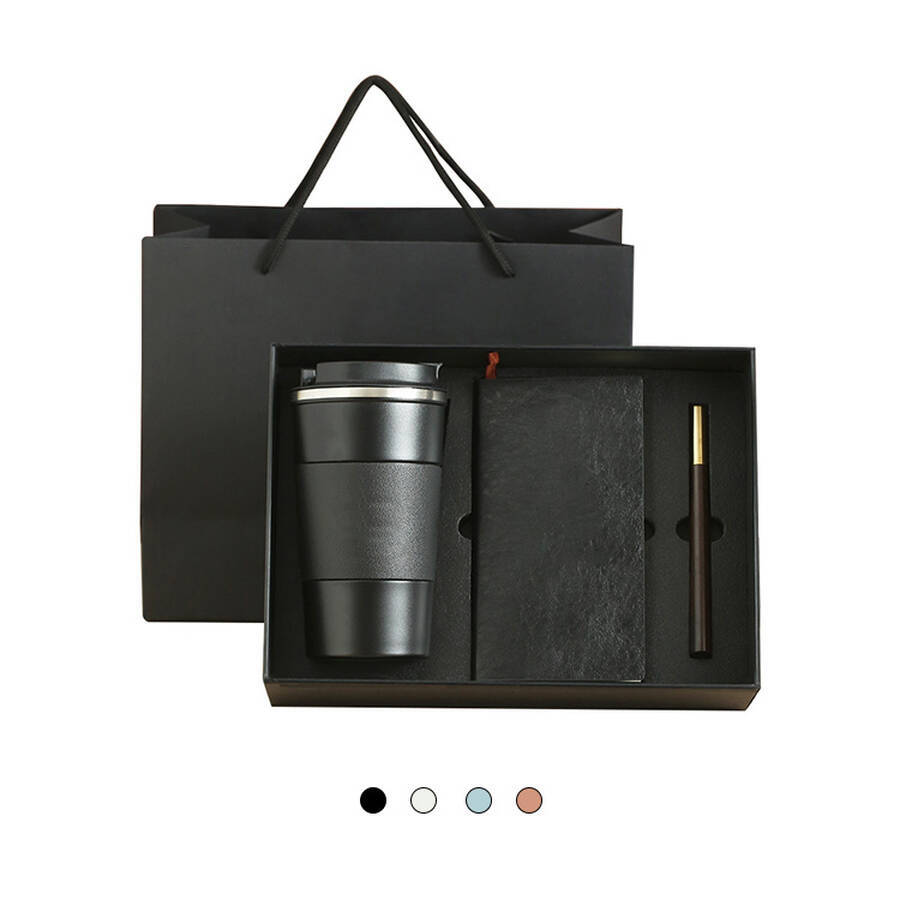
In a boxed program, capacity affects the bottle, insert, box depth, supporting products, master cartons, and receiving storage. Approve the bottle and packaging as one system.
Start with the complete component list
List confirmed and optional items before fixing capacity. A notebook often defines the basic footprint of an office set; the bottle must align beside or above it. Pens, cards, cables, pouches, and technology accessories use the remaining length, width, or depth.
Proportion matters more than maximum size. A large bottle can dominate the box and compress supporting items, while a very small bottle may look weak inside an oversized insert. The preferred range should preserve clear positions and enough finger space for removal.
Technology accessories introduce irregular dimensions through cables, plugs, cases, and adapters. Pouches and compact umbrellas create different length and depth requirements. If several versions of a set share one core bottle, pack every planned combination in the same box structure before approving a modular insert.
A change in water bottle capacity can require a new insert rather than a simple product swap. Confirm the external dimensions of every shortlisted model early so that later accessory changes do not create unexpected packaging revisions.
Box depth is often the hidden constraint
A bottle may fit the available length and width but still require a deeper box because of its diameter, lid, or handle. Build a three-dimensional mock-up and confirm that the box closes without pressure. Excessive space allows movement; an overly tight insert can damage the presentation.
What to Confirm Before Requesting a Quote
A useful inquiry should allow the supplier to compare actual models, not guess from a general request. Record the capacity direction and the physical limits that led to it.
The practical next step
Compare models against your real limits
Send the quantity, use scenario, capacity range, maximum dimensions, component list, logo file, destination, and required delivery date. Ask for a sample or exact specification sheet before approving the full order.